Characteristics
- Interactive fiction: using text commands to control game-play

Phoenix Wright: Ace Attorney, DS:
Examine: examine the background (character sprite disappears)
Move: go to another location
Talk: talk to character
Present: use item to with the character to gain more information to order to advance plot.
- Minimal game-play (a lot of clicking)
- Due to that, it is products of both commercial and smaller independent game companies.
- Static images: usually Japanese anime styled art
- PC and more recently portable console (DS) based
- Main target market is East Asia and a smaller niche market in the West.
- Larger projects have a choose your own adventure game-play with multiple endings.
- Smaller independent/fan created projects has a more linear style game-play.
And finally,
- Yes, there is a large market for visual novels aimed at adults but that is not to say that all visual novels are like that.
Style:
- Narrated in a mixture of first and third person.
Phoenix Wright: Ace Attorney: Talking with Larry.
- Formulaic (eg, beginning of the day, events of the day, end of day, repeat)
- Normally first person perspective
- Generic backgrounds with character sprites
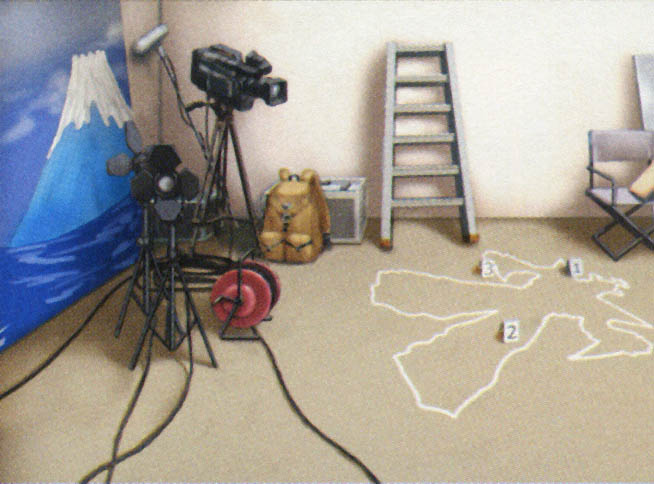
Phoenix Wright: Ace Attorney: You play Phoenix who's a lawyer and the object of the game is to investigate the crime scene, compile evidence and use them in court.
- Detailed computer graphical (CG) content at key points in the plot.

Lux Pain: "AND I WILL TAKE OVER THE WORLDDDDD"
So, why a visual novel?
- Pretty artwork- Story/plot orientated
- Quirky characters

The cheering squad from Osu! Tatakae! Ouendan. You are part of the "support squadron" and your mission is to solve the world's problems by dancing and cheering!
- Not mainstream
- Due to the game's nature, it is dependent on mostly music.
- I enjoy playing them.
Some pictures of games with amazing artwork and graphics that I've played find hugely inspiring:

I love the in game graphics and artwork of The World Ends With You, it's vibrant and full of style. 'Cutscenes' are done in a comic-y style and since the plot is set in Shibuya, Japan, the music reflects it with it's Japanese pop/hip hop style.

It's really hard to find decent artwork of Hotel Dusk: Room 215 on the internet, but I've managed to find a website with loads of animated gifs of the rotoscoped animation.
Hotel Dusk Fansite
Love the animation and the Film Noir atmosphere it gives. Too bad the company is bankrupt even with the sequel on the way.

Lux Pain is probably the closest to a visual novel game that I've played. The audio really helped the graphical content and heightened the atmosphere of the game, especially in the ominous parts of the plot.
Since the plot revolves around psychic detectives, the main character can 'see' the thoughts of the characters. The text float and 'shudder' on the screen while the audio plays some creepy atmospheric music which I found surprisingly effective especially when playing at night in the dark.
Mini Lux Pain Rant:
The only bit which I hated about Lux Pain were the amount of translation errors! I understand that translating Japanese into English is hard enough as it is, but there were typos, grammar errors and at some points gender confusion.
The voice acting at important scenes in the game didn't even match up to the text which amazing was quite good (the American voice acting that is). It's shocking that the quality of the game is so low for an official release which is a shame, there was a lot of potential for the game.
So, to add to the 'why a visual novel' section
- to use audio in a way to improve game-play quality in a way that (mostly) Lux Pain failed to do and
- to use audio to improve how readers would read 'interactive fiction' in a comic style.

No comments:
Post a Comment